Downspout Drainage: Where Should the Water Actually Go?
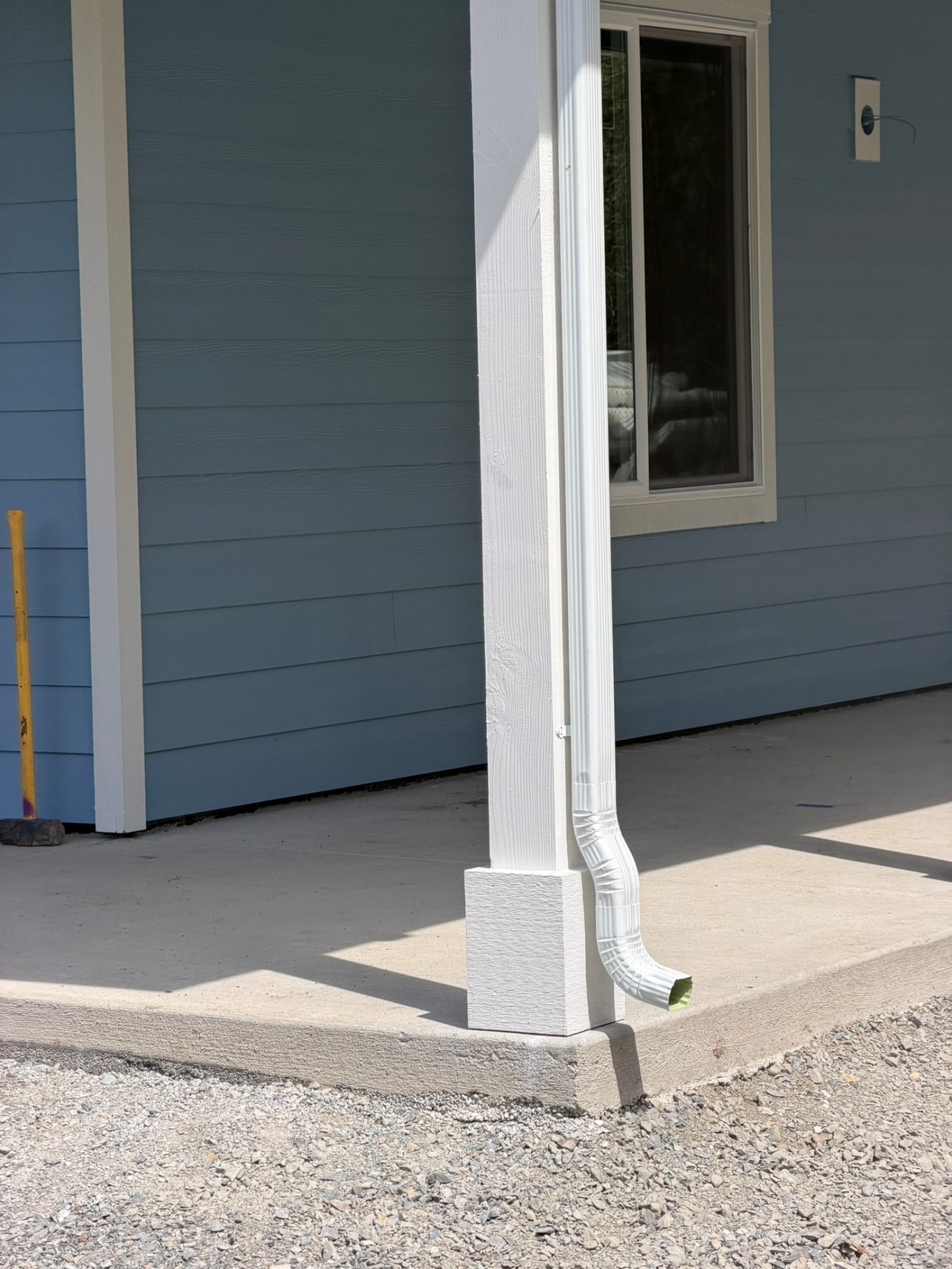
A gutter system's whole job is moving water off the roof, but a downspout that dumps that water two feet from the foundation hasn't actually finished the job — it's just relocated the problem eighteen inches closer to your basement wall. Most downspout guides are step-by-step trench-digging tutorials. This is the part that actually matters more: how far is far enough, what happens when it's wrong, and what Washington's own drainage rules say that almost nobody's ever read. A basement window well is a related drainage detail with its own code requirement, covered separately in the post on window well drainage.
How far is actually far enough
The consistent baseline across building-science sources is a minimum of 5 feet from the foundation for a simple above-ground discharge, or at least 10 feet if the water is routed through underground piping first. Home inspectors and contractors tend to recommend the same range in practice — 4 to 6 feet as an absolute minimum, 10 feet as the real target, more if there's a basement involved. Roger Cook, the longtime landscape contractor on This Old House, puts the mechanism plainly: water discharged too close to the house "can infiltrate the foundation and be wicked up the side of the house, wreaking havoc along the way in the form of mold, insects, or rot." The specific number matters less than the principle — the water needs to actually leave the vicinity of the house, not just clear the wall by a foot or two.
Above-ground extensions vs. underground drainage
Whichever route you go, it starts with the same small fitting connecting your downspout to whatever comes next — covered in more depth in the post on downspout adapters. A simple flexible or rigid above-ground extension is the cheapest fix and a genuinely reasonable weekend project — typically $10-50 for a flexible extension, up to a few hundred installed. It's also the most visible, the easiest to accidentally kick or run over with a mower, and the one most likely to end up quietly pointed the wrong direction after a season or two. Underground drainage — solid pipe buried in a sloped trench to a discharge point well away from the house — costs more (roughly $100-300 for a basic buried run, more for a full French drain or dry well system) but stays out of the way and keeps working without anyone remembering it's there. Neither is wrong; it's a real tradeoff between upfront cost and long-term reliability. A downspout filter installed at the top of that underground run is worth knowing about too — it protects the buried pipe from sediment, though it doesn't do much for the gutter itself.
The mistake that undoes everything else
One warning shows up consistently across building-science and contractor sources, and it's worth taking seriously: never tie a downspout into a perforated foundation footing drain. Those drains exist to relieve water pressure away from the foundation; feeding roof runoff and debris directly into that system defeats the purpose and can actively soak the foundation instead of protecting it. If your downspout drainage and your footing drain are two different systems, keep them that way.
Corrugated pipe vs. smooth-wall PVC — an honest take
Corrugated pipe is cheaper and easier to work with by hand, which is why it's what a lot of DIY extensions default to. It also needs a steeper minimum slope to drain properly, its ribbed interior traps more debris and silt over time, and it's structurally weaker under load than smooth-wall PVC. That said, real long-term field reports are mixed rather than uniformly damning — some buried corrugated runs hold up fine for 15-20 years, others need attention within 5. PVC is the more reliable default for anything you don't want to think about again, especially on a longer run with a flatter available slope, but corrugated isn't an automatic failure if the slope and soil conditions cooperate.
Slope: the part everyone gets wrong
A buried downspout line needs real, consistent slope to actually drain — a commonly cited minimum is around 5/8 inch of fall per foot of pipe. Get this wrong and the failure mode isn't dramatic, it's slow: water sits in the low spots of the pipe between rain events, sediment settles out of that standing water instead of washing through, and the pipe's effective capacity shrinks a little more with each storm until it backs up during the next heavy rain. It's the kind of problem that's invisible until it isn't.
Why this matters more on Puget Sound soil specifically
This region's geology gives downspout drainage a genuine local wrinkle most national guides never touch. Much of the Puget Sound lowlands sit on glacial till left behind by the Vashon Glaciation — a dense, poorly-draining mix of clay, silt, sand, and gravel sitting over the more permeable Esperance Sand, with a nearly impermeable layer of Lawton Clay in between that traps water right where it collects. Disturbed soil backfilled around a foundation during construction is naturally more permeable than the undisturbed till around it, which means it can collect and hold water like a shallow bowl instead of letting it disperse — sometimes called the "clay bowl effect." Combine that with a regional rain pattern that's persistent rather than intense — closer to 150 rain days a year of steady, sustained rainfall rather than short bursts — and mild winters that rarely freeze the ground solid, and groundwater here just keeps moving all winter instead of locking up. None of that is abstract: standing water against a foundation exerts real hydrostatic pressure, roughly 0.43 psi for every foot of depth, enough at 10 feet to push over 4 psi against a foundation wall — pressure that shows up over time as bowing walls, slab heave, or water finding its way through the smallest crack or joint.
The Washington-specific rule almost nobody's heard of
Washington's Department of Ecology actually publishes real, specific standards for downspout drainage in its Stormwater Management Manual for Western Washington, under what's called a downspout dispersion system — and most homeowners have never heard of it. A splash block or dispersion pad is limited to handling 700 square feet of roof area each. A dispersion trench needs at least 10 feet of trench per 700 square feet of roof it serves, capped at 50 feet of total trench length, with a minimum 5-foot setback from the trench to any structure or property line. Beyond the outlet, a vegetated flow path is required — 25 feet to a structure or property line, 50 feet if the ground slopes more than 15%. That property-line setback matters more than it might sound: dumping roof runoff toward a neighbor's yard is a real, documented source of neighbor disputes, not just a theoretical courtesy issue.
DIY or call someone?
A basic above-ground extension is a reasonable DIY project for almost anyone. A buried system with correct slope, proper pipe selection, and a real discharge point that doesn't just move the problem onto someone else's property is where it's worth having someone who does this daily take a look — especially on a lot with basement walls, a slope toward the house, or any history of dampness. Getting the distance right but the slope wrong solves nothing; getting both right the first time is worth paying for.
What I actually see go wrong most
The single most common issue I run into isn't a missing extension — it's an extension that exists but empties four feet from the house onto ground that slopes right back toward the foundation, undoing the whole point. The second most common is a homeowner who added an extension after a wet basement scare, but never checked whether the underground pipe feeding it was already partially clogged or crushed, so the water still backs up before it ever gets that promised 10 feet away. A drainage system is only as good as its worst section, not its best one.
Frequently Asked Questions
How far should downspout extensions extend from the house? A minimum of 5 feet for a simple above-ground extension, 10 feet or more if it's tied into underground piping — more with a basement or ground that slopes toward the house.
Can I install this myself, or should I hire a professional? A simple above-ground extension is a reasonable DIY project. A buried system with real slope requirements and a proper discharge point is worth having someone experienced handle, especially with a basement involved.
How deep should underground extensions be buried? Deep enough to maintain consistent slope over the full run — typically a shallow trench is fine, but the slope (not the depth alone) is what actually determines whether it drains.
What maintenance do downspout extensions actually need? A periodic check that the discharge end hasn't shifted, settled, or gotten buried, and that any buried pipe hasn't developed a low spot where sediment can collect.
Do downspout extensions really prevent basement flooding? They're one real piece of the picture — properly routing roof water away from the foundation reduces the soil saturation that drives basement seepage, but it works alongside good grading and gutters that aren't clogged in the first place, not as a standalone fix.
Not sure if your downspouts are actually routing water far enough away? See the gutter repair & maintenance service or reach out for a free estimate — I'll take a real look at where your water's going and tell you honestly whether it's fine or worth fixing. If overflow at the gutter itself is the issue rather than what happens after, here's how to spot a clogged system early.
Sources: This Old House, Building America Solution Center (DOE), Washington State Department of Ecology Stormwater Management Manual, NDS Drainage Pipe Guide, Today's Homeowner, RMAX.