The Best Gutters for a Climate That Rains for Months: An Honest Verdict
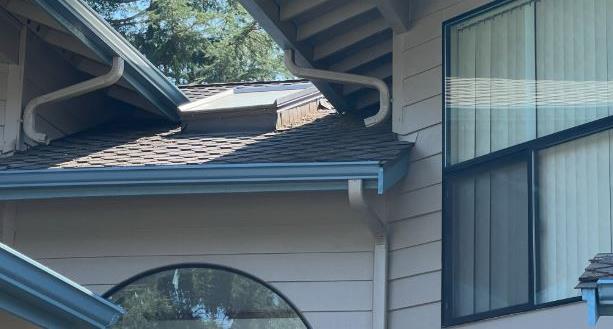
Search for the best gutters and you'll get fourteen articles that carefully explain every material ever invented and then end with "it depends on your needs." That's the home-improvement equivalent of a fortune cookie. I've already written a full post on every one of these materials and profiles individually, so this one does the thing those posts couldn't: it picks a winner. Specifically, a winner for a region where the rain shows up in October, gets comfortable, and doesn't really leave until someone asks it to.
The short version: what I install, and why
For the large majority of South Sound homes, the best gutter system is seamless aluminum, .032" gauge, K-style profile, 5-inch or 6-inch depending on the roof, with 3x4-inch downspouts. That combination handles sustained rain, resists rust without depending on a coating, and costs a fraction of the materials that technically outlast it.
- Material: aluminum — it doesn't rust, and it isn't relying on a coating to not rust.
- Gauge: .032" heavy-gauge, not the .027" industry middle ground and definitely not the .019"-.025" stuff on a retail shelf.
- Profile: K-style, unless the house has genuine historic character.
- Size: 6-inch on most real rooflines here; 5-inch is still right on a small, simple, moderate-pitch roof.
- Construction: seamless, roll-formed on site. One piece per run, not a chain of sections holding hands.
Everything below is why. If you want to skip to the part where I tell you what I won't put on your house, that section exists too, and it's blunter.
Why "best gutters" is a climate question before it's a product question
The best gutter material depends almost entirely on what the weather actually does where you live. Here, the stress isn't ice expansion or hail — it's time-of-wetness. Metal that stays wet for months corrodes differently than metal that gets soaked and then bakes dry, and that single fact reshuffles the whole ranking.
A lot of gutter content aimed at Washington warns about freeze-thaw cycles, which is advice written for Minnesota and mailed to the wrong address. Our winters are mild. What we actually have is volume and duration: Olympia averages about 50.6 inches of rain a year per NOAA's 1991-2020 climate normals, and the Tacoma/Sea-Tac corridor runs closer to 37 inches. More importantly, as I covered in the gutter sizing post, it arrives as long multi-day systems rather than short violent bursts. A gutter here doesn't need to survive one dramatic punch. It needs to keep working through six straight hours of unglamorous drizzle — and in Thurston County, that's spread across roughly 167 rainy days a year.
Best gutter material: the full comparison
Here's every material I've researched on this site, side by side, with the lifespan and cost figures pulled straight from those individual posts. Two things to notice: the longest-lasting material is not the one I recommend, and the cheapest material is the one I recommend against hardest.
| Material | Typical lifespan | Installed cost | Fit for months of sustained rain | Verdict |
|---|---|---|---|---|
| Aluminum | 20-30 years | $6-12/ft nationally; $6.40-$11.10/ft Tacoma area | Excellent — doesn't rust, no coating to breach | Best overall. What I install. |
| Copper | 100+ years | $25-74/ft depending on style | Excellent — oxidation layer gets more protective with age | Best if you're staying put and want it. A real upgrade, not just a look. |
| Zinc | 40-80 years with proper care | $30-50/ft | Good, if it drains and dries between storms | Fine material, hard to staff. Every joint needs welding or soldering. |
| Galvanized steel | ~20 years retail-grade; up to 50 with G-90 coating | Between aluminum and the premium metals | Risky — rust starts at cut edges, holes, and scratches | Only for real impact risk or a deliberate industrial look. |
| Wood | Up to 50 years with annual upkeep | $32-45/ft for a historic cedar profile | Demanding — rot starts at end grain and spreads into fascia | Restoration and preservation requirements only. |
| Vinyl | 15-20 years (cost guides); 20-25 (NAHB component study) | $3-9/ft | Poor on a house — a joint every 10 feet, all of them moving | Sheds, outbuildings, short-term rentals. Not a primary residence here. |
Figures carried over from this site's individual material posts, linked throughout. Cost ranges are consumer and trade cost-guide ballparks, not quotes.
So why does aluminum win if copper lasts five times longer?
Because "best" isn't a synonym for "longest-lasting." Aluminum wins on the one thing that matters most in a wet climate — it doesn't rust, and unlike galvanized steel it isn't depending on a coating to pull that off. Pair that with a price that makes it a default instead of a conversation, and it's the right call on most houses.
Copper is genuinely great, and I'll install it happily. It doesn't rust, it reasonably lasts 100 years or more, and in this wet, mildly marine climate it reaches full green verdigris in something like 5-7 years instead of the 15-20 that drier regions see. Over a 50-year ownership horizon, the cost math closes up more than the sticker price suggests, because aluminum gets replaced once or twice in that window and copper gets replaced zero times. Copper is also the one material that fights our regional algae-and-moss staining problem on its own, since copper ions are measurably toxic to algae. There are two honest asterisks: the upfront number is three to four times aluminum's, and copper theft for scrap is a documented, actively prosecuted pattern in this region — not a ghost story contractors tell to sell aluminum.
Galvanized steel is the one people are most surprised I skip. Steel genuinely beats aluminum on dent resistance. The problem is the failure mode: rust on galvanized steel doesn't appear randomly, it starts at cut edges, drill holes, and scratches, then spreads outward from that point. Every field-cut miter and every fastener hole is a candidate. In a climate where the metal stays damp for months, a coating-dependent material is a bet, and I'd rather not make it with your fascia board as the stake.
Gauge: the spec that separates a good aluminum gutter from a sad one
Gauge is the thickness of the aluminum coil, and it's the single most-ignored spec on a gutter quote. I install .032" heavy-gauge on most South Sound jobs. It's roughly 18% more metal than the .027" industry standard, and that shows up directly in dent resistance and how straight a long run stays after twenty years.
| Gauge | What it is | Where it belongs |
|---|---|---|
| .019" - .025" | Light builder-grade and retail stock | Sags and dents its way toward replacement early. Skip it. |
| .027" | The industry-standard middle ground | Fine on shorter, simpler rooflines |
| .032" | Heavy-gauge, ~18% more metal than .027" | My default here, especially on long runs and steep pitch |
Five thousandths of an inch sounds like a rounding error. It is also the entire difference between a gutter that still looks installed in year twenty and one that looks like it's slowly melting off the house. Nobody has ever called me to say they regretted the thicker metal.
Best gutter profile: K-style or half-round?
K-style is the better default for the large majority of homes here. It holds more water at the same nominal width, it's available in seamless aluminum everywhere, and it costs less to install and eventually replace. Half-round earns its place on genuinely historic architecture — not on a 1998 ranch with vinyl siding.
The numbers behind that, from the full profile comparison: K-style makes up something like 80% of residential gutter installations, and a regional Pacific Northwest sizing reference puts a 6-inch K-style at roughly 14.0-15.5 gallons per minute against roughly 12.5-14.0 GPM for a 6-inch half-round. That's a real edge, but a modest one — not the dramatic gap some marketing implies. Half-round does have a legitimate advantage here that I won't pretend away: its smooth curve doesn't give fir needles the corners to pack into the way K-style's angled trough does, and in a region where conifers shed nearly year-round, that's a practical point, not a brochure line.
Where half-round loses most people is the invoice. Nationally K-style runs roughly $9-$41 a linear foot installed depending on material, half-round roughly $13-$44, and copper half-round turns into a genuinely different conversation — real homeowner quotes for full-house copper half-round have landed in the $24,000-$30,000 range. Half-round is also harder to find someone to install well, since most crews don't stock the bracket system. I'll install either. I just won't talk you into copper half-round on a house that would be perfectly happy with aluminum K-style for a third of the price.
Best gutter size: 5-inch or 6-inch?
6-inch, for most real rooflines in this part of Washington. A 6-inch gutter holds roughly 2.0 gallons per linear foot against a 5-inch gutter's roughly 1.2 — close to 70% more capacity. On a small, simply-shaped roof with a normal pitch, 5-inch still does the job and there's no reason to pay for capacity you won't use.
The sizing tables back that up. Manufacturer tables built on SMACNA sheet-metal formulas rate a 5-inch gutter for roof planes up to about 2,500 square feet at a 1-inch-per-hour rain rate at level pitch, and a 6-inch for up to about 3,840. A commonly used rainfall-tiered rule puts homes under 40 inches of annual rain comfortably on 5-inch, 40-60 inches into 6-inch-recommended territory, and 60+ into 6-inch-necessary. Thurston County sits solidly in that middle band and much of Pierce County isn't far behind. Two rules of thumb worth knowing from This Old House: Norm Abram sizes roughly 1 square inch of downspout cross-section per 100 square feet of roof, and Tom Silva wants at least two downspout outlets on any run 60 feet or longer. Which is why I spec 3x4-inch downspouts rather than 2x3 on most jobs — the gutter above them can only drain as fast as the pipe below them allows.
Yes, 6-inch looks chunkier if you stand directly beneath it and stare. Nobody does this. People do, however, notice a stain running down the siding from the one corner that couldn't keep up, and they notice it from the driveway.
Seamless or sectional? This one isn't close.
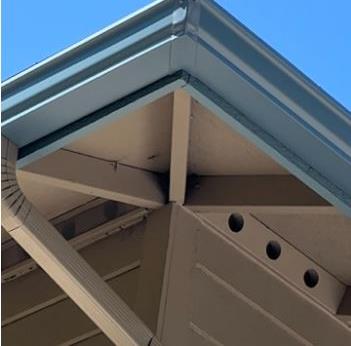
Seamless, on any house you plan to keep. Sectional gutter is commonly sold in 10-foot lengths joined by couplers, so a 40-foot run needs at least three sealed joints — every one of them a sealant or gasket holding back water while temperature cycling works it loose. A seamless run has no joints at all along a straight section.
The mechanism is real and boring, which is why it gets skipped: metal and plastic both move with temperature, and one trade source cites a 4-meter uPVC run moving 6 to 8 millimeters between hot and cold. Multiply that by a few hundred temperature swings a year, add UV slowly degrading the sealant, and you have a joint that's being mechanically worked and chemically broken down simultaneously. I'll be straight about one thing: I've looked for a credible statistic on what percentage of gutter leaks specifically start at seams, and I couldn't trace any of the numbers floating around to a real source — so I'm not going to hand you one. The mechanism stands on its own.
Sectional does have one honest advantage, and it's not nothing: you can install it yourself without a truck-mounted forming machine. If DIY genuinely matters to you more than long-term joint count, that's a real trade, not a mistake.
What I won't install, and what I'd talk you out of
Short list, plainly stated. I don't install vinyl or steel gutters on homes in this area, and I'll tell you why before you ask.
- Vinyl on a house — no. PVC expands and contracts with temperature roughly three times more than aluminum does, which works every one of those 10-foot joints harder than a seamless run even has joints. It's a legitimate choice for a shed, an outbuilding, or a rental you're not keeping, and I'd rather say that honestly than pretend vinyl is useless. On your primary residence, no.
- Galvanized steel — only with a real reason. Mature trees dropping heavy limbs, a genuine impact concern, or a deliberate industrial aesthetic. Otherwise the cut-edge rust mechanism is a bet I wouldn't take in a climate this wet.
- Zinc — I'd ask one question first. Zinc is a legitimate 40-80 year material, but every joint has to be professionally welded or soldered. If you're seriously considering it, ask any installer whether they've actually welded zinc seams before. If they look at the ceiling for a second before answering, you have your answer.
- Wood — restoration only. Wood gutters can reach 50 years, but only on an annual cycle of painting the exterior and oiling the interior. That's not a maintenance schedule, it's a relationship. Worth it on a historic home with a preservation requirement; not worth it anywhere else.
- Copper half-round on a builder-grade home — I'd talk you out of it. Not because it's bad. Because aluminum K-style does the job for a fraction of the cost and the house isn't asking for the upgrade.
The part that beats every material choice: installation
The best gutters installed badly will lose to average gutters installed well, every time. What actually ends a gutter's life is rarely the metal. It's hanger spacing, slope, and fasteners — and all three are decided on the day of the install, not by the material on the invoice.
A real trade standard calls for hangers no more than about 2 feet apart, with some contractors going closer to 16 inches on-center; brackets found 30+ inches apart are a documented defect that leads to sagging long before any material would fail. Spikes — the old nail-style fastener — are widely recognized as the weakest point in a gutter system, working loose from thermal movement and the weight of wet debris until they back out of the fascia entirely. And once repeated overflow softens the fascia board, the wood is dictating your gutter's lifespan, not the aluminum. Worth saying honestly: I couldn't find independent data tracking the actual average age at which gutters get replaced in the real world. The 20-30 year figure traces to manufacturer and industry surveys, not a study of failures. Treat it as a reasonable range, not a promise.
Keeping debris out extends all of this, which is a whole separate decision — I've covered that in the honest rundown on gutter guards rather than cramming it in here.
Frequently Asked Questions
What are the best gutters to get? For most homes in a wet climate like this one, seamless .032" aluminum K-style in 5-inch or 6-inch depending on roof size and pitch. It resists rust without relying on a coating, costs a fraction of copper or zinc, and holds up to months of sustained rain.
What is the best material for gutters? Aluminum for most homes, copper if you're staying long-term and want the look and lifespan. Copper reasonably lasts 100+ years against aluminum's 20-30, but runs $25-74 per linear foot versus roughly $6.40-$11.10 locally for seamless aluminum.
Are seamless gutters really better than sectional? Yes, for a home you're keeping. Sectional systems need a coupler roughly every 10 feet, and each one is a sealed joint that temperature movement and UV work on for the life of the system. Seamless has no joints along a straight run.
Is .032" gauge actually worth the upgrade over .027"? On most homes here, yes. It's roughly 18% more metal, and that extra thickness shows up directly in dent resistance and in how straight a long run stays over twenty-plus years of water weight and sagging risk.
Should I get 5-inch or 6-inch gutters? 6-inch on most real rooflines in this region — it carries close to 70% more water per foot, which matters during long sustained rain rather than a short shower. 5-inch is still correct on a smaller, simply-shaped roof with moderate pitch.
Are expensive gutters worth it? Sometimes. Copper and zinc genuinely last decades longer, so the math can work over a long ownership horizon. But a premium material installed with poor slope and spaced-out hangers will still fail early — spend on gauge and installation quality before you spend on exotic metal.
What gutters should I avoid on a house in Western Washington? Vinyl on a primary residence, and galvanized steel without a specific reason for it. Vinyl's joints move about three times more than aluminum's, and steel's rust starts at cut edges and fastener holes, which a climate this wet does not forgive.
Want the deeper dive on any single piece of this? Here's the full material breakdown, plus the standalone posts on aluminum, copper, galvanized steel, zinc, wood, and vinyl — and on profile, size, seams, and how long any of it actually lasts.
Ready to find out what the best setup is for your specific roofline? See the seamless gutter installation service or reach out for a free estimate — I'll walk your roofline, look at the pitch and where the water actually concentrates, and tell you honestly which of the above your house needs and which parts it doesn't.
Sources: figures in this post are carried over from this site's individual material, profile, size, and lifespan posts, which cite This Old House, NOAA U.S. Climate Normals, SMACNA Architectural Sheet Metal Manual, NAHB Study of Life Expectancy of Home Components, HomeGuide, Angi, Fixr, Sheffield Metals, GalvInfo, ASTM D1784, VMZinc, and FGIA.