How to Pressure Wash a House Without Wrecking It
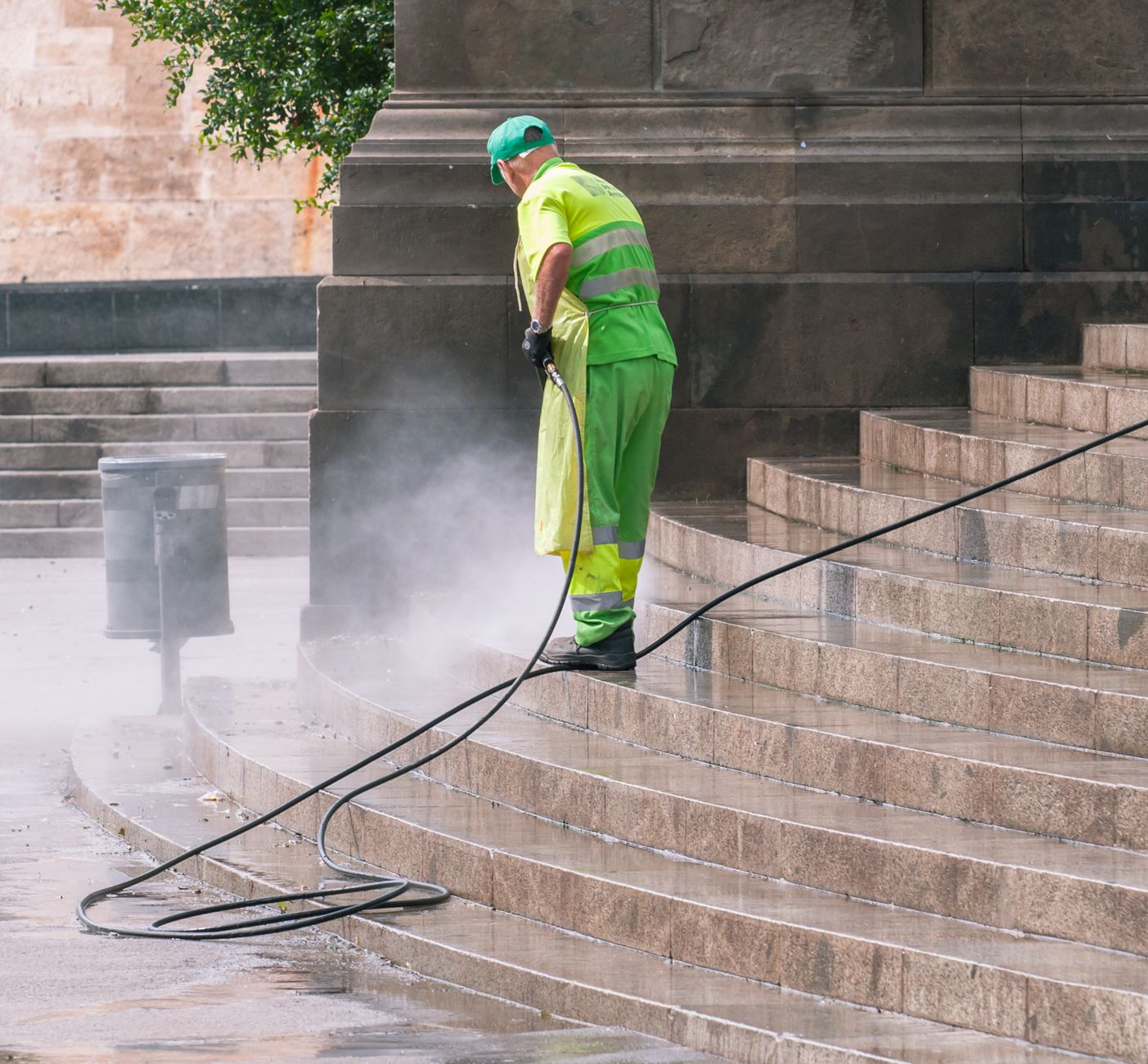
Short version: use a wide tip, keep your distance, never aim upward, let the soap do the work, and rinse from the top down. The pressure matters far less than where you point it.
Worth knowing who writes the other guides on this: every top result is a company that sells pressure washers or an insurer warning you about them. Nobody selling a 3,100 PSI machine leads with the fact that your siding tolerates about half that.
Pressure Washing or Soft Washing?
Pressure washing removes things mechanically — force against a surface. Good for concrete, driveways, masonry. Soft washing applies a cleaning solution at low pressure, lets it dwell, then rinses. Professional soft-wash pumps run around 100 PSI, roughly a thirtieth of a consumer gas machine.
Which you need depends on what's on the wall. Road grime comes off with pressure. Moss, algae and mildew are alive, and force only removes the visible part — the organism comes back. That's a chemistry problem, and here it's most of the problem. NOAA's 1991–2020 normals for the McMillin Reservoir station in Pierce County show 45.13 inches of rain across 166 days a year, about 72% of it October through March, concentrated in the months when nothing dries out. Matt Dobson of the Polymeric Exteriors Association notes mildew "will be on one or two sides of a building where there's less sun." So pressure alone buys you a clean wall for one season; chemistry buys you one that stays clean longer, and trimming back whatever shades that side beats both.
The Numbers That Actually Matter
Surfaces have pressure limits, and they don't agree with each other:
- Wood decks and fences — 500 to 1,500 PSI
- Vinyl siding — 1,300 to 2,000 PSI
- Concrete — 2,500 to 4,000 PSI
- Paint stripping — 4,000 PSI and up
Read the middle two together. Vinyl siding tops out around 2,000 and concrete starts at 2,500. One machine at one setting cannot correctly do both your driveway and your siding. That single fact is behind a large share of the damage I get called to look at.
A standard consumer gas pressure washer puts out 3,100 PSI. James Hardie, the only manufacturer I found publishing hard numbers, permits pressure washing its siding with conditions: "using wide fan tips that are kept a minimum of 6 feet from the wall and at pressures under 1500 psi will minimize the chance of damaging the siding." Three variables, not one — pressure, tip width, distance.
The nozzle colours are the specification. Red (0°) belongs nowhere near a house and yellow (15°) strips things; green (25°) is general-purpose and white (40°) is for softer surfaces. Black is the soap tip, low pressure by design — which tells you the machine was built expecting a detergent-and-dwell workflow.
Don't Aim Up. That's the Whole Secret.
The vinyl siding industry's own guidance is "hold the power washer straight at eye level. Do not aim the stream upward."
Siding is lapped — each piece overlaps the one below, like shingles, so water running down the outside stays outside. Spray upward and you drive water under the laps into the wall. Sidler describes it exactly: "if you aren't careful with your aim, you can shoot pressurized water up under the clapboards or shingles and into the walls." Tom Silva of This Old House has the best framing for why it matters: "Siding is a raincoat for your house. If you've got a hole in the raincoat, you've got problems."
So why do soft wash companies spray upward from the ground?
This is the question homeowners ask most and almost never get answered. Soft washing is advertised as ground-level work, which means spraying upward. Every guide says never spray upward. Both can't be right.
The rule is about force, not direction. What drives water past a lap joint is impact pressure. A soft-wash system runs around 100 PSI — barely above a garden hose at 50 — through a wide spray, so it wets the wall and runs back down rather than being injected behind it. At that pressure, upward application is fine. That's precisely why the method exists. At 2,000 or 3,000 PSI through a narrow tip, angled up, you're injecting water into the wall cavity. Same direction, completely different physics.
So the question to ask isn't "will you spray upward." It's "what pressure are you applying at the wall." One real exception regardless of method: vented soffits are open to your attic by design. Anything sprayed up into them goes somewhere you don't want water.
The Order of Operations
- Close everything and cover the plants. Windows, doors, drop cloths over shrubs
- Test an inconspicuous spot. Detergent manufacturers specifically instruct this
- Apply detergent bottom up. Counterintuitive, but it prevents the streaks you get when solution runs down over dry siding
- Let it dwell 5 to 10 minutes. The step people skip, and the step that does the cleaning. Don't let it dry
- Rinse top down, wand at eye level, never angled up
For mold and mildew the vinyl siding industry suggests 30% vinegar to 70% water, and keeping undiluted bleach, solvents and grease remover off siding entirely. And a warning straight off a detergent manufacturer's data sheet: "water pressure alone may remove paint, or highlight existing discoloration caused by the sun's UV rays." Washing an old painted house sometimes just reveals the condition it was already in.
Where the Wash Water Goes Is a Legal Question Here
Nobody writing national guides mentions this, and in Washington it's real.
The state's municipal stormwater permits — Pierce County and Tacoma fall under the Phase I permit — treat building washdown as a conditionally allowable discharge, and the condition that matters most for homeowners is detergent: the permit covers "routine external building washdown that does not use detergents." Soap changes the category. A second provision requires assessment for commercial and multi-story residential buildings built or renovated between 1950 and 1980, the PCB era — and single-family homes are explicitly exempt from that part. Underneath it sits RCW 90.48.080, making it unlawful to discharge polluting matter into state waters.
Practically: keep soapy water on the lawn and out of the street drain, use the least amount of the least toxic detergent that works, and sweep debris rather than flushing it. One counterintuitive note — Ecology's own guidance recommends "high pressure, low volume nozzles" to minimize water use. High pressure isn't universally the villain; it depends on what you point it at.
When to Hire Somebody Instead
Do it yourself if it's a single-story house with vinyl or aluminum siding in decent condition, you can reach everything from the ground, and you'll work at low pressure with a wide tip.
Call someone if it's two stories — Nationwide's guidance is blunt, never use a ladder while pressure washing, because the recoil can put you off it. Same answer for old paint or soft masonry, where forcing water into the structure is the real risk; for fibre cement siding, which some manufacturers don't recommend pressure washing at all; and for growth that keeps coming back, which is a chemistry and shade problem rather than a pressure one.
If you're thinking about the roof at the same time, don't. Read what roof maintenance actually involves first — roofs have their own rules, and high pressure takes the granules off your shingles.
Frequently Asked Questions
What PSI should I use on a house? For vinyl siding, 1,300 to 2,000. James Hardie specifies under 1,500 PSI with a wide fan tip at least 6 feet from the wall. A standard consumer gas machine runs 3,100, so you'll be throttling down.
Is it legal to pressure wash my house in Washington? Yes. Washing without detergent is treated as a conditionally allowable discharge, and single-family homes are exempt from the PCB assessment that applies to some 1950–1980 commercial buildings. Keep soapy water out of the storm drain.
Why does the mold come back so fast? Pressure removes what you can see, not the organism. On a shaded north wall in this climate it re-establishes quickly. Soft washing and more sunlight both last longer than force.
Want it done without water behind your siding? See the pressure washing service or reach out for a free estimate — I'll walk the property and tell you honestly whether it's a soft wash, a pressure job, or something you could handle yourself on a Saturday. Pricing questions: what power washing actually costs here.
Sources: James Hardie Technical Bulletin 20, Polymeric Exteriors Association, Dultmeier Sales, Rust-Oleum technical data, Nationwide, This Old House (Tom Silva), The Craftsman Blog (Scott Sidler), Family Handyman (Matt Dobson), Washington State Department of Ecology (Phase I and Phase II Municipal Stormwater Permits), RCW 90.48.080, NOAA National Centers for Environmental Information (1991–2020 Climate Normals), Bob Vila.