Seamless Gutters, Explained Honestly: What They're Made Of and What Actually Holds Up Here
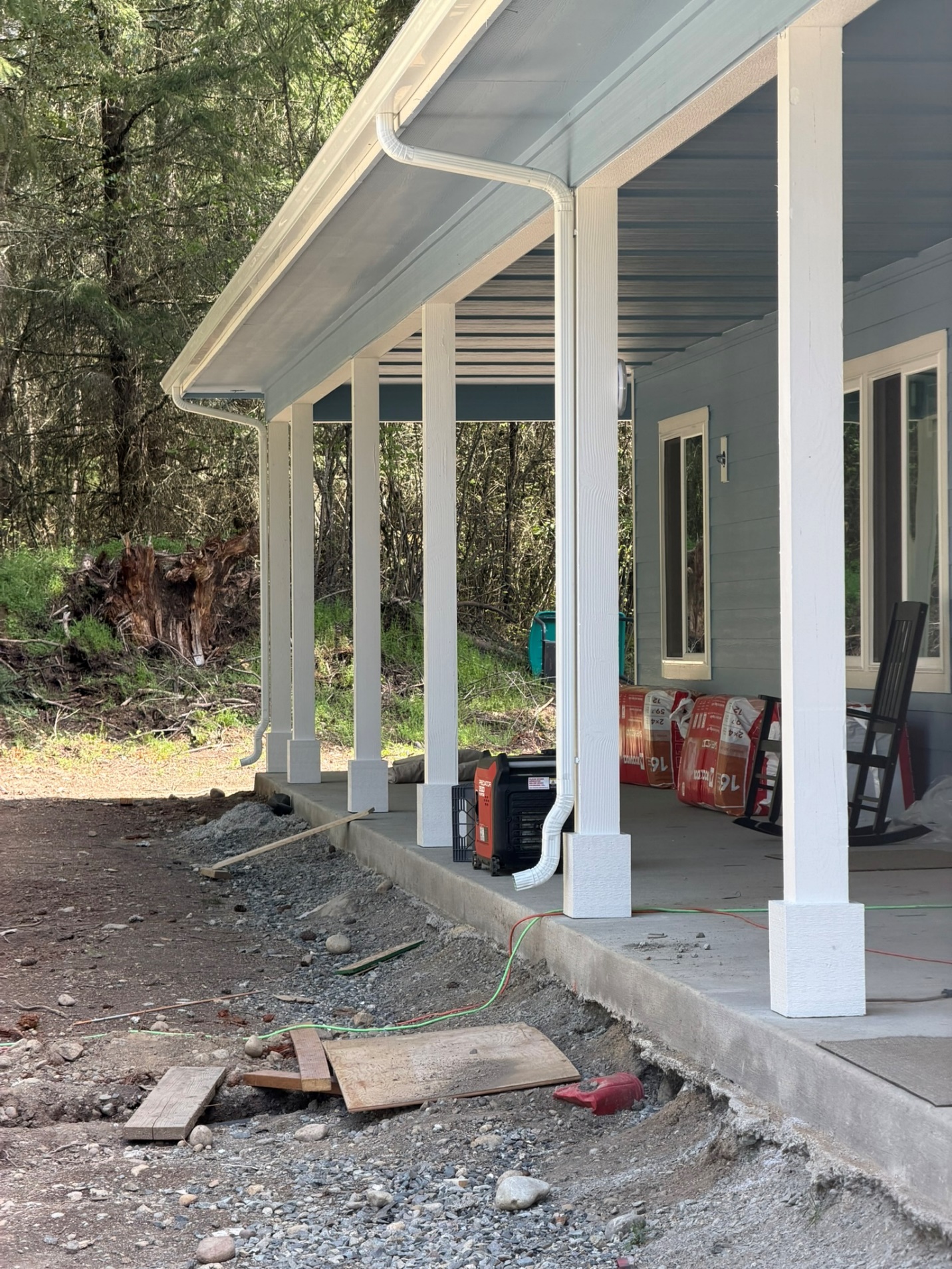
A lot of gutter content aimed at this region gets the climate reasoning wrong. You'll see plenty of pages warning about "freeze-thaw cycles" like you're in Minnesota. Western Washington winters are mild — that's not really our problem. What actually stresses a gutter system here is months of sustained rain and a steady supply of fir and pine needles, not ice expansion. Once you fix that framing, choosing a material gets a lot more straightforward.
What "seamless" actually means
Seamless gutters are formed on-site, on the spot, from a continuous coil of metal fed through a portable rolling machine — so a full run along your roofline comes out as one piece, with joints only at corners, downspout outlets, and end caps. Sectional gutters are pre-cut lengths, usually 10-20 feet, joined together with connectors and sealant at regular intervals. Fewer joints means fewer places for a leak to start — that's the entire case for seamless in one sentence, and it happens to be true.
Material comparison, honestly
- Aluminum — typically lasts 20-30 years. Rust-resistant, lightweight, and the standard seamless material almost everywhere. The one real weak point: the protective coating can wear thin over decades, and enough temperature swing can loosen fasteners over time. Still the right default for most homes in this climate.
- Copper — 50+ years, doesn't rust, and develops a green patina that actually protects it further as it ages — it can even self-heal minor scratches. The tradeoff is cost, usually $25-40+ per linear foot, and fewer installers work with it regularly.
- Galvanized steel — stronger than aluminum and rated for a similar 20-30 year lifespan on paper, but that number assumes the zinc coating stays intact. Once it's breached — a scratch, a ding from a falling branch — steel rusts fast in a climate this wet. Heavier and more work to install, too.
- Vinyl — the cheapest option and fine for a shed or a dry climate, but it's a poor fit here specifically: it bows under sustained heavy rain flow and gets brittle enough to crack during a cold snap. Not what I'd put on a South Sound home.
Why aluminum (and copper) actually fit this climate
Aluminum and copper are the two materials that hold up best against constant moisture without rusting, which is the whole game in a region that stays wet for months at a stretch. That's not a coincidence — it's why aluminum is the material I install on the large majority of jobs, with copper reserved for homeowners who want the look and are fine paying for it. Steel's coating-dependent rust resistance is a bigger gamble here than in a drier climate, and vinyl's cold-snap brittleness is a real risk in a Western Washington winter even without heavy snow load.
Gauge matters more than people think
Aluminum gutters come in different thicknesses, most commonly .027" and .032". The difference sounds small, but .032" is roughly 18-19% more metal, and that extra thickness shows up directly in dent resistance and how straight a long run stays over 20 years of sagging risk. Most of what gets built with cheaper, thinner stock is fine in a moderate-rainfall climate. Given how much sustained water volume this area actually sees — not snow load, water volume — I lean toward the heavier .032" gauge on most installs, especially anywhere the roofline is long or feeds a lot of water into one run.
Why seams still matter, even done well
Sealant at a joint dries and shrinks over years, and temperature cycling stresses that joint every time it happens. Add standing debris pressing water against a seam, and it's not hard to see why that's where leaks start first. I want to be honest here: I haven't found a solid, independently verifiable statistic on exactly what percentage of gutter leaks start at seams specifically — plenty of gutter company websites throw out a number, but I couldn't trace any of them to a real source, so I'm not going to hand you one either. What I can tell you is the mechanism is real, and fewer seams is fewer chances for it to happen. That's reason enough.
What I actually install
For most South Sound homes, that's seamless aluminum, and I lean toward .032" gauge over the thinner .027" when the roofline or rain load calls for it. Copper comes up for homeowners who specifically want it — it's a legitimate upgrade, not just a look. I don't install vinyl or steel gutters on homes in this area; I'll tell you honestly if I think a different material actually makes sense for your specific situation, but for the climate we're in, that's rare.
Frequently Asked Questions
Do seamless gutters really never leak? No system is leak-proof forever, but seamless removes the majority of the joints where leaks typically start, which is a real, meaningful difference over sectional.
Is .032" gauge worth the extra cost over .027"? For most homes here, yes — the extra thickness pays off in dent and sag resistance over the life of the gutter, especially on longer runs.
Should I get copper instead of aluminum? Only if you want the look and the lifespan and don't mind the cost — aluminum performs well here too and costs a fraction as much.
Do you install vinyl or steel gutters? Not typically — I don't think either is the right fit for this climate, and I'll say so upfront rather than sell you something I wouldn't put on my own house.
How do I know which material and gauge my home actually needs? That depends on your roofline length, pitch, and how much water it's actually moving — worth a real look rather than a guess.
Curious what seamless aluminum would actually look like on your home? See the seamless gutter installation service or reach out for a free estimate — I'll look at your roofline and tell you honestly what material and gauge make sense.
Sources: This Old House, Werner Roofing, Gutter.day, LeafGuard, Seattle Gutter Co., Amigo Gutters, Spectra Gutter Systems, OneWay Exteriors.